 Kids Portal For Parents India Kids Network
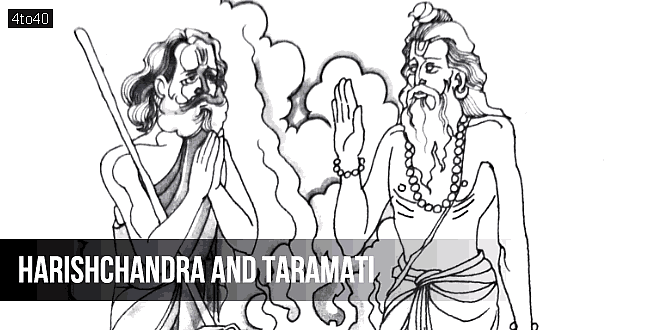
Long, long ago there lived a king in Ayodhya named Harishchandra. He was the most generous king on the earth. His reputation as an unconditional ‘giver’ spread far and wide. When Sage Vishwamitra, who was known for his temper, heard this, he decided to visit King Harishchandra himself and check out his reputation.
Sage Vishwamitra held a grievance against King Harishchandra. A short while ago, five heavenly nymphs from Indra’s court had secretly entered his hermitage and stolen all the flowers. Vishwamitra was very annoyed with them. He ordered the creepers in the garden to entwine themselves around the apsaras and take them prisoner. When the apsaras cried out for help, King Harishchandra, who was passing by, set them free. Ever since that incident, Vishwamitra was very angry with Harishchandra. Now he wanted to see if Harishchandra was prepared to make amends.
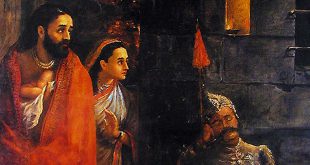
Harishchandra and Taramati: Legendary figures from Hindu mythology
As soon as King Harishchandra saw Sage Vishwamitra enter his palace, he came down from his throne and welcomed him. He showed his respect by washing his feet and making sure that Vishwamitra was comfortable. “Well, Harishchandra,” said Vishwamitra without any preamble, “I am told you are the most generous king on earth. Tell me, what are you prepared to give a sage like me?”
“Anything you desire, my… Lord,” replied Harishchandra readily. “It is yours for the asking.
“Indeed!” said Vishwamitra with a sneer. Easy enough to say it! But are you really prepared to do it?”
“Try me and see,” said Harishchandra modestly with a smile. “I feel honoured to be of service to you.” Not refusing small favours is not a difficult thing to do, especially if one is a king,” said Vishwamitra.
“But what if I were to ask for something really big?”
“Please let me know what your wish is. I will be very happy to carry it out for you,” said Harishchandra, wondering what Vishwamitra had in mind and why he had such a mysterious smile.
“Very well. I trust you,” said Vishwamitra, “but later, don’t say that I didn’t caution you.
All the people present looked curiously at sage Vishwamitra and he stared at them. “All of you here and the Gods above are my witnesses. King Harishchandra has vowed to give me what I ask for,” he said aloud.
“Well then, Harishchandra, I ask for your entire kingdom, which comprises the whole earth,” the sage declared loudly.
‘It is yours, my Lord,” said Harishchandra without batting an eyelid.
“Very well, I accept your gift. But being a king, you
Ought to know that every gift to a Brahmin should be followed by a dakshing (cash gift). Where is my Dakshina Harishchandra?
“I am sorry; I had forgotten. I shall ask my treasurer to give you 4 hundred gold Coins immediately,” said Harishchandra
Your treasurer? Vishwamitra laughed. “Nothing is yours any more! Have you forgotten that you have just gifted me the entire Earth with whatever it contains? The gold coins are not yours to give away. In fact, the very land you are standing on now belongs to me and you have no right to stay here.”
Harishchandra hung his head. He realised that he now owned nothing on earth
“Better Pay me my dakshina and then go out of my land with your wife and son,” said Vishwamitra.
The people in Harishchandra’s kingdom were shocked at the happenings. They felt sad for themselves and their pious king too. They begged Vishwamitra to have mercy and return Harishchandra a small fraction of his kingdom.
“No, I shall not,” said Vishwamitra sternly. Nor the ground under his feet. Harishchandra has made a gift of his kingdom. It will be a shame asking for it back, asking anything back, my Lord. I am not asking Harishchandra, “But if I may not live in a corner of your land, amidst my people, where should I live?”
“Varanasi is not part of your kingdom,” said Vishwamitra. “It is the abode of Shiva. You may go and live there with your wife and son, but not until you have paid me my dakshina. I don’t care how you raise it; give it to me.
Harishchandra promised to give it at any cost before sunset. He then went to his wife, Queen Taramati. She had already heard everything. But she was a brave woman and was determined to stand by her husband. “We have no time to lose, my Lord,” she
told her husband.
“What matters more than anything else is your promise to Vishwamitra. Since we have nothing to call our own, you must sell me and raise the money,” the queen said. “Ask the people if anyone is willing to buy a maid and pay the money to the old sage.”
“I cannot do any such thing, Taramati,” said Harishchandra, breaking down. “You are the queen of this land, not just my wife. As your husband, I am bound to protect you all my life. How could I possibly sell you and that too, to a commoner?”
“I am no longer a queen, just as you are no longer a king,” said Taramati. “Keeping your word is more important than protecting me. Come, my Lord. It’s getting late. The sun will set before long.”
Harishchandra dried his eyes and walked to the marketplace with Taramati and Rohit.
His voice did not shake as he cried, “Does anyone need a maid? Please speak up if you do. You can have her for four thousand gold pieces An old Brahmin who needed someone to do all the housework came forward and paid the money. As Taramati was about to leave, little Rohit started crying and held firmly to her sari.
“Please let him come with me,” pleaded Taramati. “I cannot leave him alone.”
“No, I cannot feed two people. said the Brahmin. Besides, he will be of no use for me, only a bother.”
“I shall feed him from my share of food and see that he does not trouble anyone,” begged Taramati. The Brahmin finally agreed to take both of them with him.
When Harishchandra paid the money, Vishwamitra, the sage, did not seem pleased.
“This is far too little to be considered dakshina; it must have at least one hundred more gold coins.” ‘But I have nothing else to sell, my Lord,’ said Harishchandra. “My wife and son were all I could call my own and I have sold them both.”
“You have yourself, don’t you?” said Vishwamitra. ‘Aren’t you worth anything at all?”
“I hadn’t thought about it,” said Harishchandra. ‘You shall have your dakshina, I promise.”
Harishchandra went to the marketplace once more and offered himself. “Does anyone need a slave? Give me a hundred gold coins and you can buy me,” he said in despair. A man, who used to cremate on the banks of the Ganga, needed a helper. He paid the money to Harishchandra and took him along. Harishchandra gave the money to Vishwamitra and at last was free from his debt.
But life was unthinkably tough for Harishchandra. He worked throughout the day and there was never a moment’s respite. And of course there was no question of payment because Harishchandra was now a slave.
Queen Taramati fared no better because she too had to work all day long. She had very little to eat, as most of the food she received she gave to her son, Rohit. One day the Brahmin said that he could not have Rohit playing about all day, doing nothing.
“But he is far too young to work,” said Taramati.
“He is not too young to pick flowers for my puja,” said the Brahmin. “Let him go to the woods every morning and fetch them. There shall be no meal for him unless he gets my flowers.”
So at the crack of dawn, Rohit would go to the forest and pick up flowers in time for the Brahmin’s puja. One morning, as he was picking up flowers in the dark, a venomous snake bit him. Rohit screamed and was dead long before anyone could reach him.
Taramati was worried when it got late and there was no trace of Rohit. She rushed to the woods and saw him lying under a champak tree.
“My precious, what has happened to you?” cried Taramati as she picked up the child in her arms. His body had turned blue due to the snake poison. When she realised that her son was dead, she cried and cried.
She returned home crying her heart out. There is nothing left here for Taramati, though, sadly.
The Brahmin looked at them and asked Taramati to go to River Ganga and get her dead son cremated.
“But I have no money to buy the wood or anything else needed for the ritual,” said Taramati. “My Rohit is a prince, after all.”
“A prince! He is the poor son of a maid,” said the Brahmin. “Go and request the slaves at the ghat to cremate him free. Perhaps one of them will oblige.”
Taramati carried Rohit’s body in her arms and walked to the banks of the Ganga. She put his body down and burst into tears. “Where are you, Harishchandra? See the plight of your own, dear Rohit! I don’t even have the money to cremate him decently!
Oh, what have I done to deserve this cruel fate? How am I to live without my child?”
Harishchandra, who had been setting fire to one of the pyres, heard her cry. When he heard the grieved mother call out his own name and that of Rohit, he rushed out. At first he did not recognise Taramati. Nor did she recognise Harishchandra. After all, both of them looked haggard and were in tattered clothes. But when Harishchandra looked at Rohit’s angelic face, he “recognised him instantly and burst into tears.
“Is this indeed my precious Rohit?” he cried. “And are you really Taramati? Tell me what has happened to him. I can’t believe this! Why couldn’t I die instead of him?”
He got bitten by a snake,” said Taramati in a broken voice. “I have no money. I know you have none either. Can you chop some wood and cremate our son? We don’t have much time.”
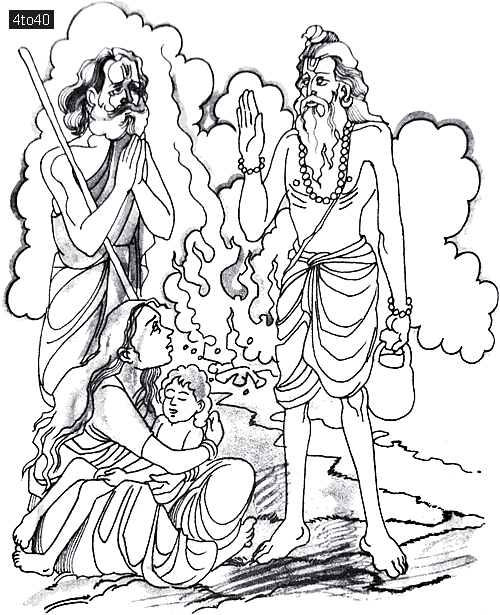
“Yes, I shall do that for our son,” said Harishchandra with a heavy heart. Just as Harishchandra was about to lift Rohit’s body and place it on the pyre, Sage Vishwamitra arrived here miraculously. He touched Rohit’s forehead and said, “Get up, my dear.” Rohit sat up, rubbing his eyes.
Before the astonished Harishchandra or Taramati could utter a word, Vishwamitra smiled at them and said, “Harishchandra, I hope you forgive me for all the hardship that I put you through. I have been testing your generosity all this time. I wanted to see whether you are really able to give away everything from your heart and without resentment. It is not an easy thing to do. But I am now satisfied that you are the greatest daata (giver) on the earth. Return to your kingdom with your wife and son with my blessings. You will live to be one of the greatest kings ever born!”
Harishchandra and Taramati touched feet in gratitude. Turning back, they saw their own chariot waiting for them to take them back to Ayodhya.