 Kids Portal For Parents India Kids Network
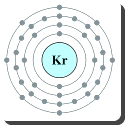 While krypton is generally an inert element, in extreme volatile conditions, it can form compounds in very small quantities. There are several ways that krypton can form its fluoride: by passing through an electrical arc, proton bombardment or photochemical process. All these processes require a very heavy amount of energy. Krypton has achieved a unique importance in science. In 1960, it was decided that the fundamental unit of length, the metre, should be defined in terms of the orange-red spectral line of Krypton 86.
Related Articles





Check Also

Dussehra Facebook Covers: Vijayadashami Social Media Banners & Posters
Dussehra Facebook Covers: Dussehra, also known as Vijayadashami, is a major Indian festival celebrated on …