 Kids Portal For Parents India Kids Network
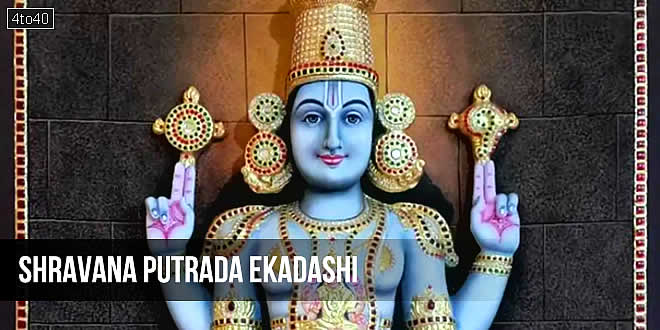
Shravana Putrada Ekadashi is of much significance to any childless couple as it is to any other devotee of Lord Vishnu. Shravana Putrada Ekadashi usually falls on the 11th day of Krishna Paksha (dark fortnight) in the Shravana month of the Hindu Lunar Calendar. It’s one of the two Putrada Ekadashi celebrated through the year, the other one being Pausha Putrada Ekadashi. Vaishnavas who are dedicated devotees of Lord Vishnu celebrate the ekadashi with extreme devotion.
Shravana Putrada Ekadashi: Date
- 2025: 05 August, 2025 (Tuesday)
- 2026: 23 August, 2026 (Sunday)
- 2027: 12 August, 2027 (Thursday)
Legend of Shravana Putrada Ekadashi:
Bhavishya Puran makes a mention of legend associated with ekadashi. The legendary tale was narrated by Lord Krishna to King Yudhisthira.
A powerful King by the name of Mahijit ruled the kingdom of Mahishmati. Despite all his riches, the King was depressed, all the while. He was childless and hence sought the advice of priests and other noblemen in the region. However, no results emerged and the King continued to remain worried.
Seeing his worries, the noblemen in his kingdom sought advice from a saint by the name of Lomesh who was considered to be a learned man. Sage Lomesh through his meditation found that the reason for the King’s present scenario laid in his previous birth.
Sage Lomesh pointed out that in his previous birth the King was a shrewd merchant who worried only about his riches. Once during a journey the merchant felt thirsty and came across a pond.
A cow was drinking water from the pond along with her calf. The merchant driven by the intensity of his thirst drove away the cow and drank the water instead. This resulted in the King being childless in his present birth. The sage advised the King and his queen fast on this day and follow the Shravana Putrada Ekadashi rituals in true earnest thereafter. The King heeded to the Saint’s advice and was blessed with a son soon thereafter.
Importance:
The birth of a son is considered auspicious in Hindu culture and devotees who observe this ekadashi festivities with devotion are blessed with a baby boy. Observing a fast in honor of Lord Vishnu is considered to be auspicious on Shravana Putrada Ekadashi and the devotees observe fast for 24 hours on the day.
Fasting on the ekadashi can be done on two consecutive days. Devotees with a family life should observe the fast on the day of actual Shravana Putrada Ekadashi. Devotees who are Sanyasi, widows and those desirous of seeking Moksha need to observe the fast on two days., both a day before and on Shravana Putrada Ekadashi.
Feeding Brahmins and offering clothes to the poor is considered auspicious and Lord Vishnu offers His blessings to those who observe this ekadashi with true devotion. This ekadashi is observed in Southern and Eastern parts of India with traditional religious fervor. North Indian states observe the other version of this ekadashi which is known as Pausha Ekadashi.
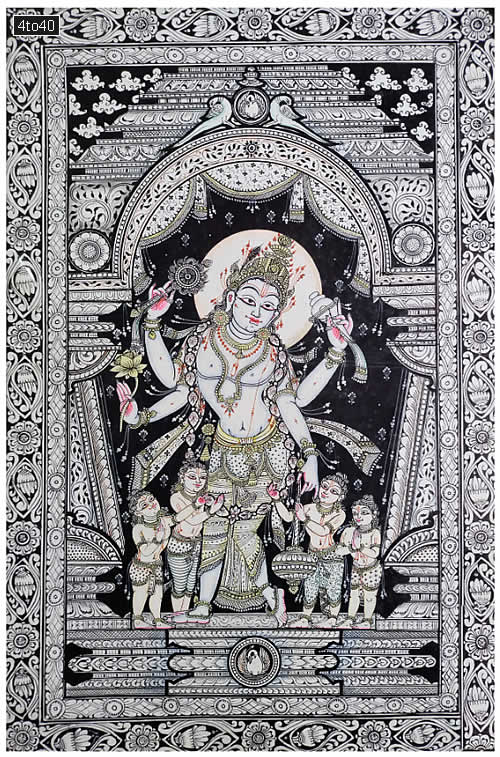
The Divine Chaturbhuja Form and its Significance:
In Hindu mythology, Vishnu is one of the principal deities in the Trimurti (Hindu trinity), representing the principle of preservation and protection. The Chaturbhuja form, meaning “four-armed,” is a powerful depiction of Vishnu’s multiple attributes and divine powers. Each of his four hands holds a symbolic object, representing his various roles and responsibilities in maintaining cosmic order. These objects may include the conch (shankha), discus (chakra), mace (gada), and lotus flower, symbolizing different aspects of his divine nature. The painting beautifully captures the majesty of this form, showcasing Vishnu’s serene yet powerful presence. The accompanying figures often represent his devotees or aspects of his divine energy, enriching the narrative and symbolic meaning. The inclusion of these figures within the composition creates a visual tapestry illustrating not only Vishnu’s supreme power but also the intimate connection between the divine and the human realm.