 Kids Portal For Parents India Kids Network
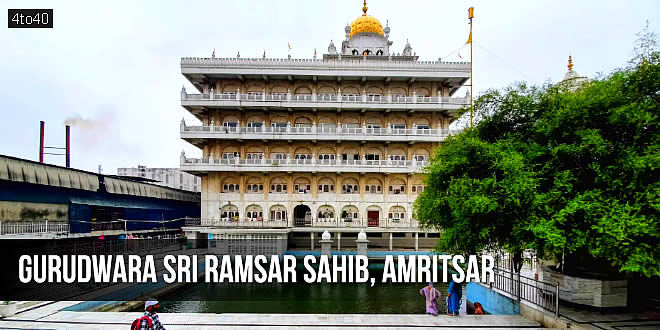
Gurdwara Ramsar stands alongside the Ramsar sarovar, the smallest of Amritsar’s five holy sarovars. Located near Chativind Gate, on the south-eastern side of the walled city of Amritsar, the present Gurdwara Ramsar is a small marble-lined hall topped by a gilded, fluted lotus dome.
It was built in 1855, at the site of the original shrine, where long before the present Gurdwara was constructed. Guru Arjun Dev, the fifth Sikh Guru who was looking for a quiet spot away from the growing city of Amritsar, chose this site as the spot where the Guru Granth Sahib would take form.
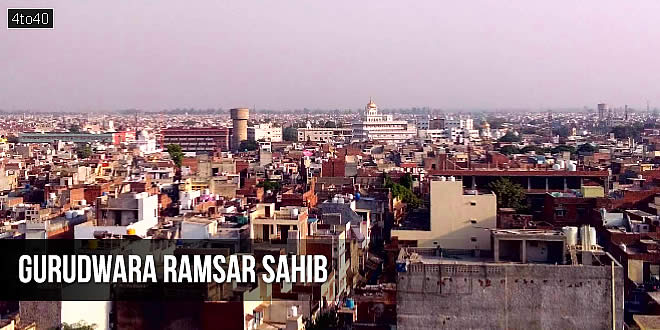
Gurudwara Sri Ramsar Sahib, Chatiwind Gate, Amritsar:
| Name: | Gurudwara Sri Ramsar Sahib |
| Location: | Sahida Sahib, Near Sahida Sahib Gurudwara, Karori Chowk, Katra Ahluwalia, Amritsar Cantonment, Punjab 143006 India |
| Associated with: | Guru Arjan Dev |
| Affiliation: | Sikhism |
| Festivals: | Baisakhi, Lohri, Guru Nanak Dev Festival, Martyrdom Day, Sangrand (Sankranti) |
| Architecture: | Sikh architecture |
| Compilation of the Adi Granth: | Sacred site where the fifth Sikh Guru, Guru Arjan Dev Ji, meticulously compiled the Adi Granth around 1603 CE |
| Construction complete: | 1855 |
Location where Adi Granth was compiled:
It was the year 1603, after the completion of the Harimandir Sahib in 1601, that the beloved Guru choose this once secluded, shady spot, about 1km away from the bustle of the town growing around the Harmandar Sahib, that the Guru set about collecting the hymns of the first four Gurus, Guru Nanak, Guru Angad, Guru Amar Das and Guru Ram Das.
Although there was plenty of cooling shade trees around and the spot provided the quiet that the Guru needed, the cooling breezes of the Amrit Sarovar were far away. To make the surroundings more agreeable, Guru ji had a small tank dug, which he named Ramsar after his father Guru Ram Das. He and his scribe, Bhai Gurdas spent over a year at the site in semi-seclusion. To the teachings of the earlier Gurus, Guruji added his own compositions, as well as selections from the writings of several Hindu Saints and Muslim Pirs that shared the principles of Sikhism.
Completion of the Granth:
After the completion of the Adi Granth (lit. First Book) in 1604 the Adi Granth was installed, with due honor and ceremony, in the Harimandir Sahib. Today the Adi Granth is known as the Guru Granth Sahib; the sacred Sikh scripture. The Guru Granth Sahib, which now spans 1430 pages, was installed by Guru Gobind Singh as the Eternal Guru of the Sikhs, shortly before his death. This unique holy book preserves the purity of the scriptures, embodying, the philosophy of the Gurus for the perpetual guidance of Sikhism, as well as other faiths.
The “Psalm of Peace”:
This spot was also where Guru Arjan Dev Ji composed his famous Sukhmani (the “Psalm of Peace”). As this site marks the exact location of the Guru’s labours and the formal beginning of the compilation of the Sikh scripture, it is only natural that this place where the current, perpetual, and honoured Sikh Guru, the Guru Granth Sahib Ji was first created, is a site of special significance for all Sikhs.
The five sacred pools of Amritsar:
Many sacred Sikh shrines can be found in the Sikh holy city of Amritsar. Of particular importance are the five sacred pools in this city. These are called sarovars and it is the practice of some Sikhs to have a dip in all five of these holy pools. The ritual, apart from the being good exercise, acquaints one with the importance of these five sites. These five holy Sarovars are: Amritsar (1586) (now used more to refer to the city rather than the sarovar), Santokhsar (1587-88), Ramsar (1602-03), Kaulsar (1627), and Bibeksar (1628). Among these famous five historical shrines is the famous Gurdwara, Ramsar. This is located south to south-east of the most important landmark for the Sikhs, the Harimandir Sahib.