 Kids Portal For Parents India Kids Network
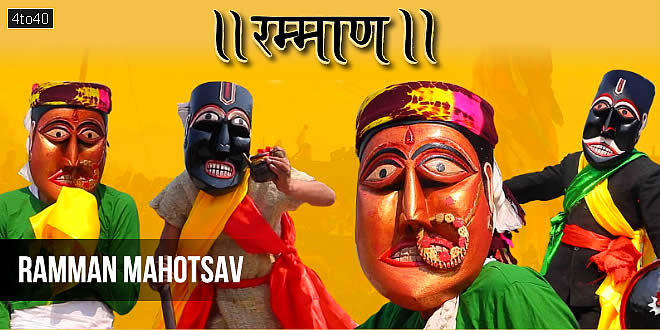
Every year in late April, the twin villages of Saloor-Dungra in the state of Uttarakhand (Northern India) are marked by Ramman, a religious festival in honour of the tutelary god, Bhumiyal Devta, a local divinity whose temple houses most of the festivities. This event is made up of highly complex rituals: the recitation of a version of the epic of Rama and various legends, and the performance of songs and masked dances. The festival is organized by villagers, and each caste and occupational group has a distinct role. For example, youth and the elders perform, the Brahmans lead the prayers and perform the rituals, and the Bhandaris – representing locals of the Kshatriya caste – are alone entitled to wear one of the most sacred masks, that of the half-man, half-lion Hindu deity, Narasimha. The family that hosts Bhumiyal Devta during the year must adhere to a strict daily routine. Combining theatre, music, historical reconstructions, and traditional oral and written tales, the Ramman is a multiform cultural event that reflects the environmental, spiritual and cultural concept of the community, recounting its founding myths and strengthening its sense of self-worth. In order to ensure that it remains viable, the community’s priorities are to promote its transmission and to obtain its recognition beyond the geographical area in which it is practised.
Ramman Mahotsav: Introduction
Ramman is a religious festival and ritual theatre of the Garhwal region in India. It is a festival of the Garhwali People celebrated in many villages of the region. Although there are many Rammans, such as the Jak Ramman, one of the most popular is the masked Ramman of the Saloor Dungra village of the Painkhanda Valley in the Chamoli district in Uttarakhand, India.
The masked Ramman is unique to the Saloor-Dungra village and is neither replicated nor performed anywhere else in the Himalayan region. The festival and the eponymous art form are conducted as an offering to the village deity, Bhumiyal Devta, in the courtyard of the village temple.
Deity:
The guardian deity of Saloor Dungra is Bhumichetrapal, also known as Bhumiyal Devta. The festival is held in her honour every year after Baisakhi, a harvest festival that also marks the beginning of the Hindu Solar New Year. On the day of Baisakhi, the village priest announces the date for the Ramman festival which falls on the ninth or the eleventh day after Baisakhi. The Bhumiyal Devta comes out in a procession to the temple on the day of Baisakhi. The second day, people offer hariyali (sprouted barley plants), to the deity who, in turn, promises prosperity to all, including agricultural yield and forest produce. Every day of the festival, the Devta takes a round of the village. The festival lasts for ten days during which time the local epic of Rama is sung and masked dances depicting different aspects of life take place in the courtyard of the Bhumiyal Devta’s temple It is said that the Ramman festival is celebrated here from a very old time for about 500 years, as well as the festival is celebrated jointly by the local panchayat for 11 to 13 days. Raman Festival Is organized here too, but It is said that this festival of Sallud and Dungra is more famous.
Festivities and dances:
The Ramman begins with an invocation to Ganesha, the remover of obstacles followed by the dance of Ganesha and Parvati. This is followed by the dance of the Sun God, an enactment of the creation-myth of the birth of Brahma and Ganesha. The other dances include the dance of the Bur Deva along with Gopi Chand (Krishna) and Radhika, the Mwar-Mwarin dance that showcases the travails of the buffalo herders and the Baniya-Baniyain Nritya (dance of the trader-couple) that shows the hardships faced by the common people. After these initial performances, the focus now shifts to the enactment of the local Ramkatha. Episodes from Rama’s life, beginning with his visit to Janakpur and culminating with his coronation following his return from exile, are sung to a total of 324 beats and steps. Another important aspect of these performances is the singing of Jagar, a musical rendition of local legends.
There are also other dances and episodes like the Maal Nritya, Koorjogi and Narsingh Pattar Nritya that follow the Ramkatha. In the Maal Nritya, a historical battle between the Gurkhas of Nepal and the local Garhwalis is comically enacted by a troupe of four dancers dressed in red and white. It is mandatory to have a red Maal from the Kunwar caste of Saloor village, as it is believed that this hamlet supported the Gorkhas while the other three are selected by the panches of the Gram Panchayat.
In the Koorjogi ceremony, weeds (koor) from the village fields are pulled out by a Koorjogi, a character who carries a sack full of these weeds. There is much merriment as people throw these weeds at each other in a spirit of a communal sport.
https://www.sangeetnatak.gov.in/public/uploads/events/16478847324914.pdf