 Kids Portal For Parents India Kids Network
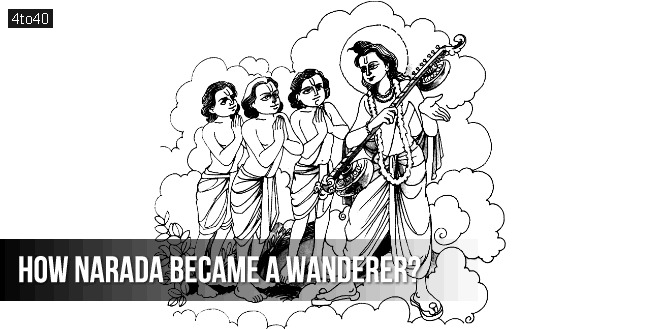
Sage Narada holds an important place in Indian mythology. He is a great scholar of arts and the Veena-playing musician for gods. A wanderer who roams freely across both heaven and earth, he is often seen as the messenger of Vishnu. The word ‘nara’ means ‘knowledge’, and ‘da’ is ‘one who gives’. So, Narada means a person who passes on knowledge and guides those who seek his advice along the path of right.
Narada, in most of the Purana stories, appears as a scholar, but he is also a bundle of playful mischief. He has a naughty, childish streak in him, and he just loves drama! He sometimes discloses the secrets of gods and demons as well as human beings to those who need not know about these. It sometimes leads to misunderstandings and quarrels between them and this is why Narada is often described as ‘one who enjoys quarrels’. Despite his mischievous nature, all gods, demons and human beings love him. His ultimate aim is to bring about justice so that the good are rewarded and the bad punished.
How Narada Became a Wanderer?
Narada is always on the move and never stays in one place for long. This interesting story in the Puranas tells us why he became a wanderer.
Long, long ago there lived a prosperous man named Dakshabrahma. He had many children. He looked forward to the time when they would grow up and help him in his work and finally get married and lead happy lives. But he realised that mere material comfort was not the only source of happiness. He felt spiritual training was also important for the wholesome development of his sons. So he called his sons and spoke to them seriously about how they planned to lead their lives.
“What would you like us to do, Father?” asked his sons.
“I’d like you to gain some spiritual knowledge, without which no one can truly grow,” said Dakshabrahma.
“So, my sons, first go and do penance. Pray to God so that he gives you true knowledge. After that you will return home. That will be the time for you to get married and lead a normal family life.”
“Very well, Father,” agreed the obedient sons. “Where should we go for our tapasya?”
“The Himalayas. No one is likely to disturb you there, and you can concentrate on your prayers.”
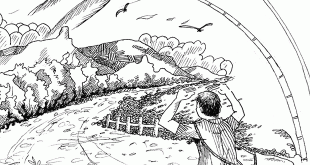
Dakshabrahma’s sons left for the Himalayas. They found an appropriate place for meditation along the bank of a crystal clear lake, the Narayana Saras. They were soon deep into meditation. This was when Narada happened to pass by and saw them praying. He was curious to know why a group of young boys had left their home and had come up to the Himalayas to pray.
“Who are you?” he asked them.
“We are Dakshabrahma’s sons,” they replied.
“What are you doing in the Himalayas?” asked Narada.
“Our father asked us to come and pray here,” said the eldest. “We shall return home after we have acquired true knowledge.”
“And what do you plan to do afterwards?” asked Narada curiously.
“Start our work, get married, of course. And lead the life of a householder,” said the boys.
Narada looked them up and down. Well, here’s my chance to have some fun! he thought mischievously.
Turning again to the boys, he said, “Dear boys, what a very foolish thing to do!”
“What do you mean?” they asked in surprise.
“Marriage brings about trouble and problems galore. Why do you wish to be bothered with such things? At the end of your tapasya, you will realise the glories of celestial life. And that is the only thing that will give you true happiness.
“I can’t think why your father wants you to get trapped in married life. Escape from it while you still have the chance,” he went on.
“Think only of the God and aspire for eternity,” he emphasised.
“Do you really mean all this?” asked the boys, surprised.
“Of course I do. You are all intelligent, and look at me; have I also not made the choice? I have never allowed the thought of marriage to cross my mind; it’s a sheer waste of energies!” he added.
“Just think about what I have told you and decide for yourselves!” said Narada. He laughed to himself as he continued with his journey.
Narada’s words had a tremendous impact on the minds of Dakshabrahma’s sons. They took a solemn vow never to get married. When Dakshabrahma sent for them, they refused to return.
“We have decided to spend the rest of our life in spiritual quest,” they informed their father.
Dakshabahma was greatly upset by their decision. He was looking forward to getting them married and having them and their families with him.
Now he called his younger sons.
“Children, before doing anything else, go and do penance. Pray to God so that he gives you true knowledge. After that you may return home. get married and lead a normal family life. It is your duty to return and help me in my old age and help the family continue,” he advised.
The younger sons promised to follow his advice.
Once in the Himalayas for their penance, Narada noticed them and approached the brothers. He repeated the same sermon that he had given to the older brothers. The younger sons felt exactly as their brothers had felt earlier. They also took a vow not to marry and instead take up the path of renunciation. When Dakshabrahma came to know about this, he was very upset indeed. This time he also got to know who had influenced his sons.
Livid with anger, Dakshabrahma faced Narada.
“Why did you mislead my young sons?” he asked Narada.
“I wanted them to marry and settle down, and be near me when I grow old.”
“Because I felt it was the right thing to do,” Narada replied.
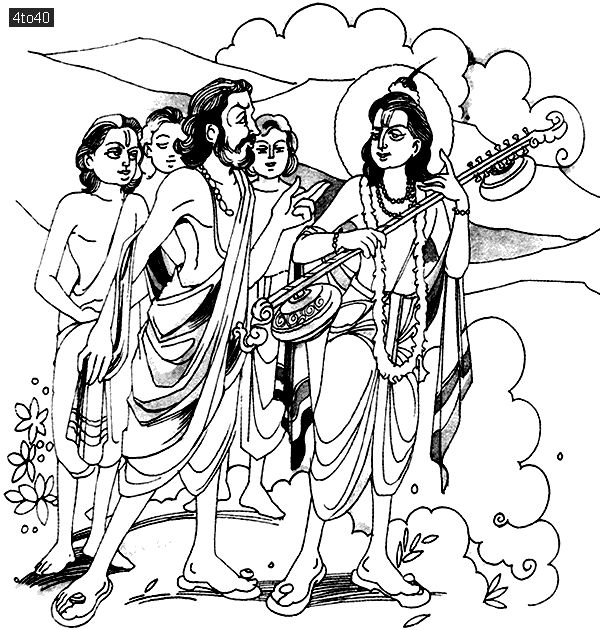
“But it was none of your business! You interfered quite unnecessarily,” cried Dakshabrahma.
“Perhaps I did!” admitted Narada.
“I shall not tolerate this. I will curse you,” shouted Dakshabrahma.
“Since you did not let my sons settle down, I curse you that you shall never settle down either! Henceforth, you shall be a perpetual wanderer, travelling between heaven and earth. You will not be able to rest in peace in one place.”
“Dakshabrahma, it shall be as you wish,” said Narada. He did not seem upset, really.
Dakshabrahma’s curse came to pass, and that is why sage Narada turned into a constant wanderer. He is still believed to be wandering somewhere between the heaven and earth.