 Kids Portal For Parents India Kids Network

Gurdwara Sri Baoli Sahib Goindwal: Goindwal is situated at a distance of 30 km south-east of Amritsar city. Here, are two historic Gurdwaras, associated with the third Guru Sri Amar Das. He provided a place of pilgrimage, alternative to Haridwar and Banaras, where God alone was to be worshipped. He planned to construct a ‘Baoli’-a well with descending steps, in Goindwal. He purchased some land and laid the foundation of the ‘Baoli’ with due religious ceremonies. His devoted Sikhs joined in the work on self-help basis and many willingly came forward to provide food for the volunteers engaged in the digging operation. The Baoli had eighty-four steps. The Guru decreed that whoever should attentively repeat Japji on every step, should escape from the travail of wandering through eighty four lakhs births and rebirths.
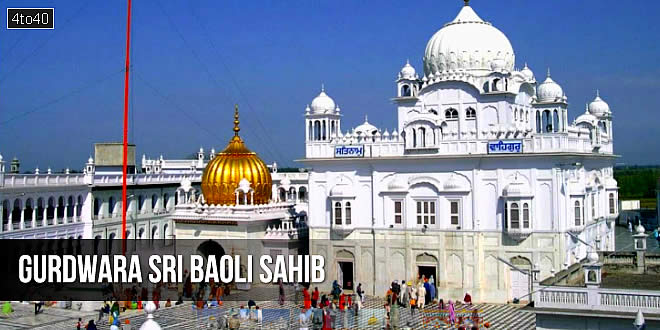
Thus the Baoli at Goindwal Sahib, became an object of pilgrimage to Hindus as well as Sikhs. This Gurudwara is considered the first great Sikh center of pilgrimage. The entrance to the Baoli has been artistically decorated. There is a row of frescoes, depicting scenes from Sikh history. A dip in the Baoli is considered most holy. Adjoining the Baoli, a magnificent Gurudwara has been built. Besides, there is ‘Langar’ the famous community kitchen of Guru Amar Das, where each visitor is offered food free of cost. It has been recorded by a Sikh historian that Emperor Akbar also took meal in the Langar, before meeting the Guru.
Gurdwara Sri Baoli Sahib Goindwal
| Name: | Gurdwara Sri Baoli Sahib Goindwal |
| Location: | Goindwal Sahib, Tarn Taran, Punjab, India [48 Kms from Amritsar / 25 km from Tarn Taran] |
| Associated with: | Guru Amar Das Ji, Guru Ram Das Ji, Guru Arjan Sahib Ji, Guru Hargobind Sahib Ji, Guru Har Rai Sahib Ji, Guru Tegh Bahadur Ji |
| Affiliation: | – |
| Festivals: | Vaisakhi |
| Architecture: | Sikh architecture |
The axis of Sikhism:
Gurudwara Goindwal Sahib, located in the Tarn Taran area of Punjab, was established in the sixteenth century under the guidance of Guru Amar Das Ji and became a vital hub for Sikhism during his reign. The gurdwara is a beautiful example of typical Sikh architecture, with a large dome tipped with a gold pinnacle. The entrance is adorned with beautiful murals highlighting important stories in Sikh history. Additionally, there is the langar, which is the famous community kitchen of Guru Amar Das Ji, where, according to a Sikh historian, Emperor Akbar took a meal before meeting the guru.
Goindwal is where Guru Amar Das first encountered Guru Ram Das. Legend has it that Goinda, a Marvaha Khatri trader, planned to establish a village at the western end of the Beas River ferry but was foiled by natural calamities. He sought the help of Guru Angad Singh and asked if one of his sons would come and settle there to reassure the people. The Guru agreed to help Goinda but none of the Guru’s sons agreed to this proposal so the Guru asked his devoted disciple, Bhai Amar Das (he would later become the guru), to help Goinda.
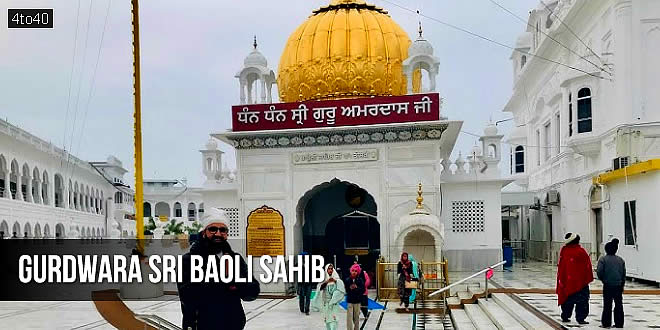
Gurdwara Sri Baoli Sahib Goindwal:
A Baoli (step well), paved with 84 steps was constructed here. Sikhs believe that by reciting Japji Sahib, the divine Word revealed to Guru Nanak Sahib Ji, at each of the 84 steps after taking a bath in the Baoli provides Moksha, liberation from 84,00,000 cycles of life of this world and unity with God (mukhti) if completed with a pure heart.
The Baoli Sahib is a large, open well, 8 metres across. Its water level is reached through a covered passage comprising a flight of 84 steps. A wide pointed archway opens on a domed clearance, four steps below the ground level, decorated with frescoes depicting the life of Guru Amar Das. The well has a few resting places between the 84 steps providing the Sikhs a place to get together and have spiritual discussion.
There are projected eaves on all sides, while the front face also has a row of small turrets. The cornice under the dome is multi-coloured with floral designs. Its cupola is painted with multi-coloured floral designs and portraits of Guru Amar Das, Guru Ram Das, Guru Hargobind and Guru Gobind Singh.
The area between the arch and the coping is covered with portraits of the Ten Gurus, and those of Baba Mohari, Baba Mohan and Baba Anand. Other paintings depict scenes from the life of Guru Amar Das. Most of the steps are covered with marble slabs donated by different Sikhs, the earliest of these being dated 1963 Bk/ 1906AD. The lotus dome above the entrance has a tall gold-plated pinnacle with pinnacled kiosks and solid decorative domes around it.
Guru Angad asked his faithful follower, Bhai Amar Das, to oversee the project of building Goindwal. Guru Angad gave Amar Das a staff with instructions that it should be used for the removal of any obstacles. Guru Angad selected Bhai Amar Das as the most faithful of his Sikhs and appointed him to be his successor.
After becoming Guru in 1552, at the age of 73, Guru Amar Das Ji moved from Khadoor to Goindwal with his family and followers. That year Guru Amar Das commenced the digging of the Baoli in Goindwal, ie. a well with steps descending down to water level. In the time of Guru Amar Das, Goindwal became the centre of an annual fair on the occasion of Vaisakhi.