 Kids Portal For Parents India Kids Network

Goa Liberation Day: Goa Liberation Day marks its 64th anniversary in 2025. Check out this article to learn and understand the history and story behind the Independence of Goa from Portuguese rule.
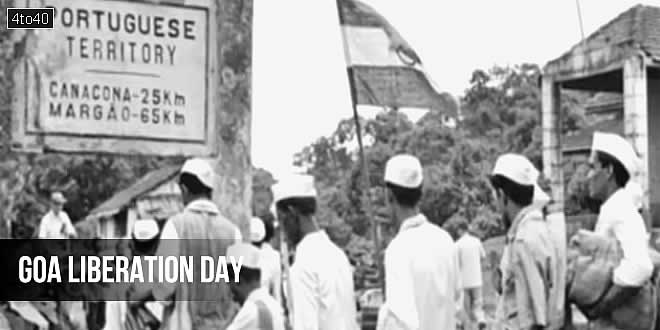
Goa Liberation Day: Goa Liberation Day annually commemorates the independence of Goa and its integration into India. The day also celebrates the success of the military operation Vijay. The year 2025 marks the 64th anniversary of the Goa Liberation against the Portuguese rule.
Goa Liberation Day: Date
- 2025: 19 December, 2025 [Friday] – 64th Anniversary
- 2026: 19 December, 2026 [Saturday]
- 2027: 19 December, 2027 [Sunday]
- 2028: 19 December, 2028 [Tuesday]
Learn about the history of Goa Liberation from Portuguese rule:
- Despite the Independence of India from British Colonial Rule in 1947, Goa was under the domination of the Portuguese who ruled the territory since 1505. The liberation of Goa, along with Daman and Diu marks the successful integration with India.
- The Portuguese are known to be the first and last European invaders of India. Alfonso Albuquerque defeated a combined fleet of Egyptian, Arab and Zamorin in the battle of Diu, and established a powerful marine force in Goa. In the year 1503, they built the first fort in Cochin and the second in Cannanore.
- The Bombay port known to Portuguese as Bom Bahia, was handed over as dowry of Catherine de Braganza to Charles II of England in 1661.
- Portuguese while ruling over Goa faced the wrath of the Maratha Empire at regular intervals. Even after regular pushback, they managed to hold on to Goa, their proud possession in the east.
- The native population of Goa was largely converted to Roman Catholicism after 1510. And this made a group of Goans opposed to Portuguese rule. They desired to control and rule over Goa. However because most Goans did not support these revolts, the movement bore no fruits.
- The Conspiracy of the Pintos, an effort by Tipu Sultan to usurp Portuguese authority in 1787, was the first such plot to undermine Portuguese sovereignty.
- The colonies had hoped for self-determination following the 1910 abolition of the Portuguese monarchy. Colonial policies, however, did not undergo any significant change.
- The “Acto Colonial” (Colonial Act), passed by Portugal that outlawed political gatherings and demonstrations in all of its colonies, marked the beginning of the independence movement.
- Goa’s anti-Portuguese activities coincided with anti-British feelings across the nation. During the 1928 Indian National Congress session in Calcutta, Tristão de Bragança Cunha, who is regarded as the founder of Goan nationalism, established the Goa National Congress. In Goa, during a satyagraha movement, the Portuguese opened fire on the willing participants. India severed its ties with Portugal in protest of the decision.
- The Indian government said that Goa should join India “either with full peace or with full use of force” after diplomatic efforts failed. There were military personnel positioned near the Goan border. Operation Vijay, a full-fledged military operation, was conducted on December 18 and 19, 1961. Manuel António Vassalo e Silva, the Governor-General of Portuguese India, signed an instrument of capitulation with very little opposition.
2 heroes forgotten amid Goa liberation day celebrations
Major Shivdev Singh Sidhu and Captain Vijay Sehgal, both hailing from Ludhiana district, lost their lives during Operation Vijay, which was carried out to liberate Goa from Portuguese rule in 1961.
As the nation marks the 63rd anniversary of Goa’s liberation from Portuguese rule on December 19, 2024, the sacrifice of two Punjab-born soldiers – Major Shivdev Singh Sidhu and Captain Vijay Sehgal – remains largely forgotten in their home state. The two young officers laid down their lives during Operation Vijay, the military action that liberated Goa in 1961.
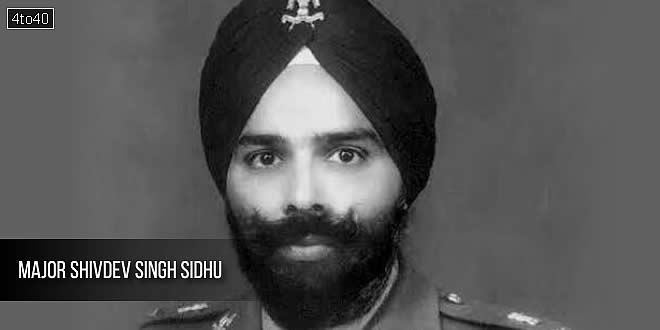
Despite their valour, successive governments in Punjab have failed to honor their legacy adequately, leaving their families and local residents disheartened. Major Shivdev Singh Sidhu, a native of Sidhwan Khurd village in Ludhiana district, was martyred at Fort Aguada while attempting to free political prisoners. Capt Vijay Sehgal, 28, who too hailed from Ludhiana, also lost his life in the same operation. Despite repeated appeals by their families, neither Punjab nor the central government has taken significant steps to commemorate their sacrifices.
While Goa has made efforts to preserve the legacy of its liberation, such as transforming Fort Aguada into a museum, the martyrs’ contributions have not been prominently acknowledged.
Former cabinet minister Maheshinder Singh Grewal, nephew of Major Sidhu, said their martyrdom is exceptional as a part of the country was liberated from the invaders after independence in 1961.
Dr Gurinder Singh Grewal, nephew of Major Sidhu, visited the museum and appreciated the Goa government’s initiative but lamented the absence of statues or memorials for the martyrs. “It’s painful that after six decades, Punjab has done nothing to remember these bravehearts who gave their lives for the nation,” he said.
Locals in Punjab echoed similar sentiments. Harjit Singh, a retired schoolteacher from Sidhwan Khurd, said, “Our children learn little about heroes like Major Sidhu in school. Punjab should establish memorials and name institutions after them so their stories inspire future generations.”
Another resident, Jaswinder Kaur, added, “We are proud of these martyrs, but it feels like the government only remembers them on anniversaries, and even then, only for political speeches.”
Maheshinder Singh Grewal said Major Sidhu’s story exemplifies courage and commitment. Born on July 2, 1926, he initially aspired to become a doctor but joined the military after being inspired by British officers visiting his college. Commissioned into the 7th Light Cavalry, he served with distinction, earning recognition for his bravery during the 1948 Zojila Pass operations. A skilled sportsman and voracious reader, he balanced military excellence with a keen intellect and diverse interests.
Further, Grewal added that during Operation Vijay, Major Sidhu’s unit played a crucial role in advancing against Portuguese forces. On the night of December 18, 1961, he led a mission to free political prisoners at Fort Aguada. Facing unexpected resistance, he was grievously injured while rescuing a fellow officer and succumbed to his injuries the next day.
Goa Liberation Day Quotes:
Here are some of the quotes on Goa Liberation Day to display the essence of this event:
- Freedom is the essence of life; Goa Liberation Day reminds us of the value of independence.
- Goa’s liberation is a tribute to the courage and resilience of its people.
- December 19 stands as a beacon of hope, reminding us that unity can overcome oppression.
- The story of Goa’s freedom is an inspiring chapter in India’s fight for independence.
- Goa Liberation Day is a celebration of liberty, heritage, and pride.
- Let’s honour the sacrifices of those who fought for Goa’s freedom.
- Goa’s liberation reminds us that the spirit of independence cannot be suppressed.
- On Goa Liberation Day, we salute the unsung heroes of the freedom struggle.
- Freedom is a right, and Goa Liberation Day is a testament to this truth.
- The courage of the Goan people shines brightly on this day of liberation.
- Goa’s freedom was hard-earned; let us cherish it and protect it.
- December 19, 1961, marks the day Goa’s heartbeat in tune with independent India.
- Goa Liberation Day inspires us to uphold unity and justice for all.
- Freedom is the soul of a nation; Goa reclaimed its soul on this day.
- Goa’s liberation is proof that perseverance and unity can overcome any obstacle.
- The beauty of Goa shines brighter because it is a land of freedom.
- Goa Liberation Day is a celebration of history, courage, and cultural pride.
- The fight for Goa’s independence is a lesson in resilience and determination.
- Liberation is not the end but the beginning of building a free and just society.
- On this day, we remember and honour the spirit of those who fought for Goa’s freedom.
Interesting Facts:
- About 36 hours were spent fighting to free Goa as part of Operation Vijay, which involved all three wings of the Indian military.
- On May 30, 1987, Goa was declared to be a state.
- About 22 Indians and 30 Portuguese soldiers died in the operation.
- The 11th Finance Commission named Goa the “Best Placed State” due to the state’s first-rate infrastructure.
- Before being granted statehood status, Goa, Daman, and Diu were a part of the Union Territory of India.
- The Goa government’s most prestigious civilian honour is the Gomant Vibhushan Award.
- Popular nuclear physicist Anil Kakodkar was the first recipient of the honour.
- The Bom Jesus Basilica and a number of other Goan structures are included in the “World Heritage Sites” by UNESCO