 Kids Portal For Parents India Kids Network
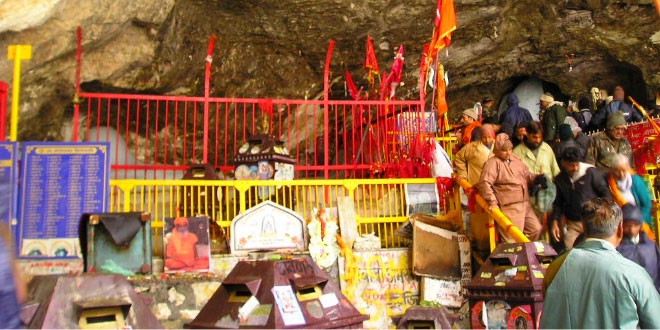
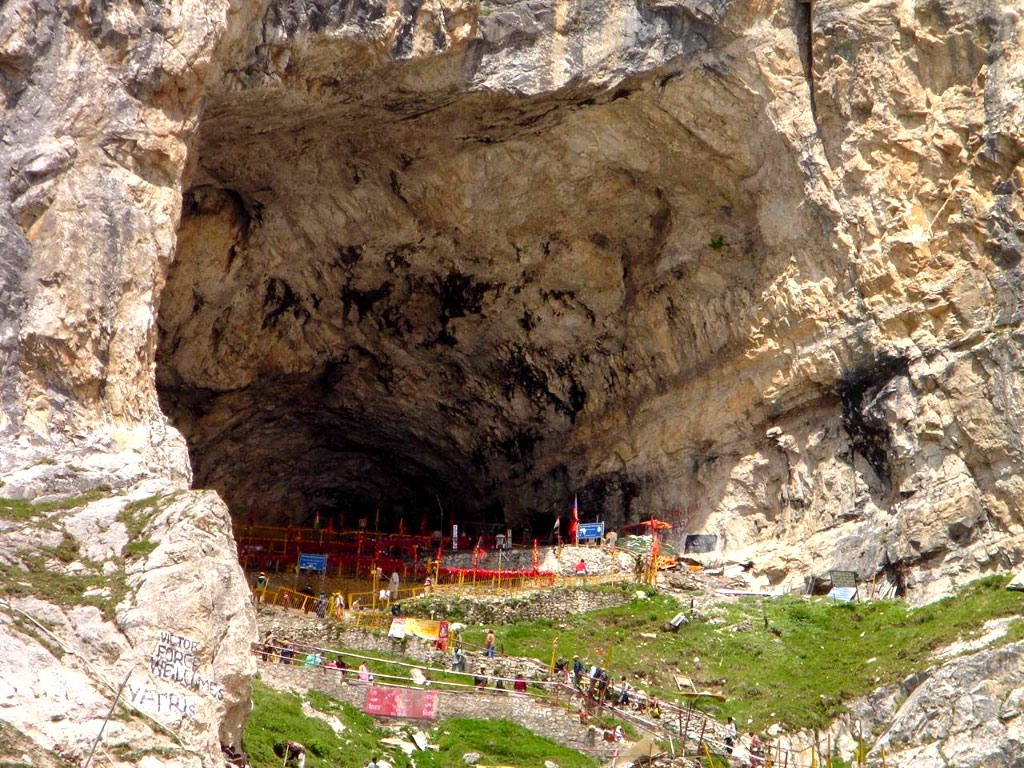
Amarnath Temple is a sacred Hindu shrine located in Kashmir and surrounded by beautiful Himalayan valleys. This ancient cave temple, dating to more than 5000 years ago, is devoted to Lord Shiva – one among the Holy Trinity of Hinduism. The temple is situated on Mount Amarnath which is about 141 km away from Srinagar-the capital city of Jammu & Kashmir and is seated at an altitude of 12,750 ft. above sea level.
| Name: | Amarnath Cave Temple [Jagatpita Brahma Mandir] |
| Location: | Pahalgam Tehsil, Anantnag District, Jammu and Kashmir, India |
| Affiliation: | Hinduism |
| Diety: | Lord Shiva |
| First reference in history: | In 11th century CE, Queen Suryamati gifted trishulas, banalingas and other sacred emblems to this temple |
| Elevation: | 3,888 m (12,756 ft) |
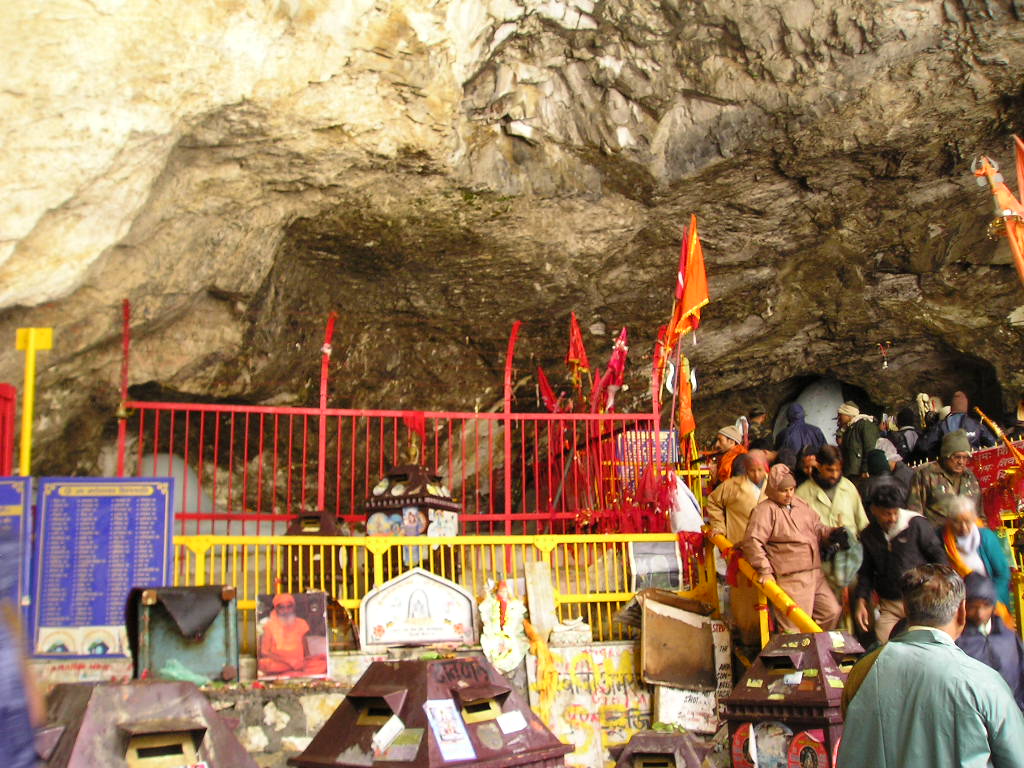
Thousands of pilgrims from places across India and the world visit this holy shrine every year, seeking salvation and inner peace. Amarnath is famous for a natural ice stalagmite which resembles the holy Shiva Linga. This natural Shiva Linga is formed when water droplets trickling down the Amarnath cave, freeze under the extreme low temperatures during the months of May to August. The structure thus formed is a white Shiva Linga which, after reaching its height in the summers, gradually melts away after August. Pilgrims to this cave can watch the water droplets fall, freeze and contribute to the growth of this holy stalagmite while it attains its maximum size.
Amarnath History:
Amarnath temple is a cave situated in the Himalayan ranges. It is believed that Lord Shiva explained the secret of life and eternity (Amar Katha) to his wife Goddess Parvati here. He wanted an isolated place for this discussion hence he stationed his vehicle Nandi (bull) at Pahalgam, Snake at Sheshnag (the lake), Lord Ganesha (his son) in Mahaguna hills, the moon at Chandanwadi and the five elements of life at Panjitarni to block any creature from reaching the cave. After ensuring that no one is around, Lord Shiva revealed the Amar Katha to Goddess Parvati. However, a pair of doves abiding in the cave overheard the secret lessons. It is believed that after hearing the secret the doves became immortal. A pair of doves that dwells in the cave is said to be the same one.
There is an interesting story regarding the discovery of Amarnath cave. A shepherd called Buta Malik once met a sage who gifted him a bag full of coal. Buta Malik, on reaching home, discovered that the entire mass of coal in the bag was replaced by gold. He understood that the sage was not an ordinary person and ran back to thank the sage at the same place they had met. However, on reaching there, he found a cave with a stalagmite Shiva Lingam instead of the saint. Buta Malik announced his discovery among the villagers and that’s how it became famous.
Hindu epics narrate another story of this cave’s discovery. It says that once when the Kashmir valley was submerged under a big lake, Sage Kashyapa drained all the water through several rivers and streams. Once the valley was restored, Sage Bhrigu, on his visit to Himalayas, discovered this holy cave.
Major Attractions:
The cave is situated in an exotic location in the Himalayan ranges. The major attraction of this place is obviously the natural Shiva Linga which is formed every year and is said to melt according to the stages of the moon. There are two more stalagmites near the temple which represents Goddess Parvati, wife of Lord Shiva and Lord Ganesh, their son. Other two major tourist attractions near Amarnath, Pahalgam and Sonmarg, are also famous and are usually crowded with pilgrims and tourists in the peak season. Pahalgam is a picturesque place seated at a height of 2133 meters in the Himalayan range. The exotic beauty of the place is intensified by the presence two rivers – Aru and Sheshnag.
The presence of the Sindh River with a backdrop of snow covered mountain ranges adds heavenly beauty to this scenic piece of land. Summer season, between April to October, is the ideal time to visit Amarnath. There are both government and private organized Amarnath Yatra Packages that can help you with a better organized pilgrimage.
How To Reach Amarnath:
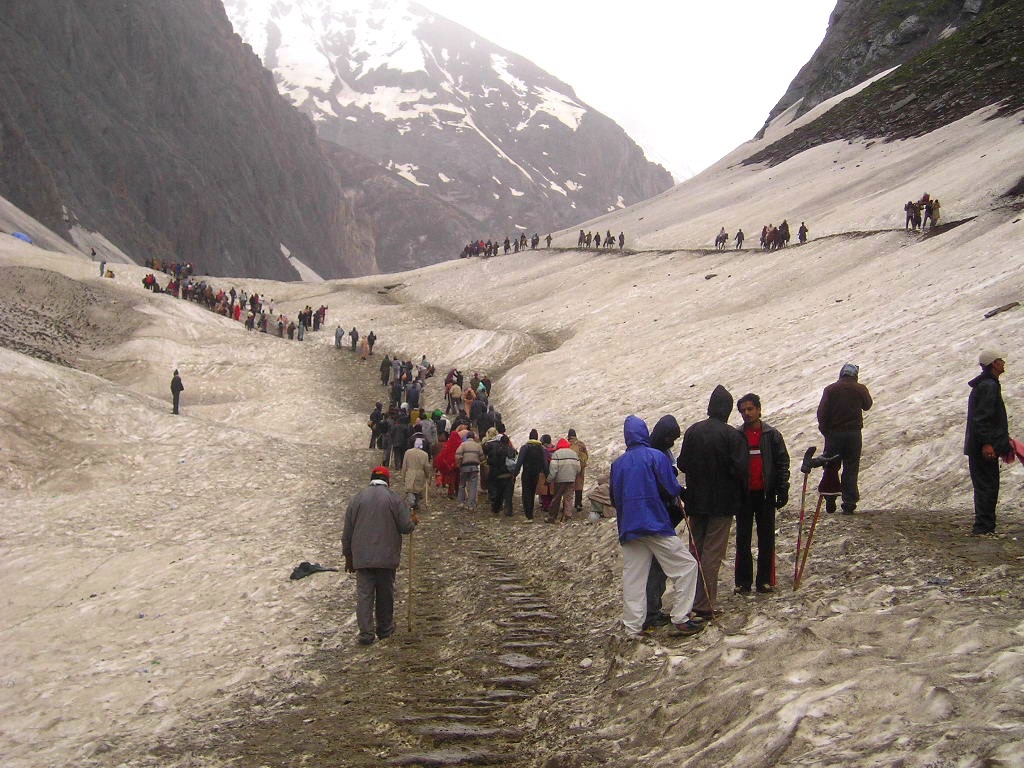
Located in the lap of the Himalayas, Amaranth is a bit arduous to reach. The nature of the terrain makes it impossible to construct roads and rails in the snow-topped areas around the cave. However, the roads takes you to the nearest possible point from where either you can walk or take pony-rides to the main temple. Pilgrims can reach Amarnath in the following ways.
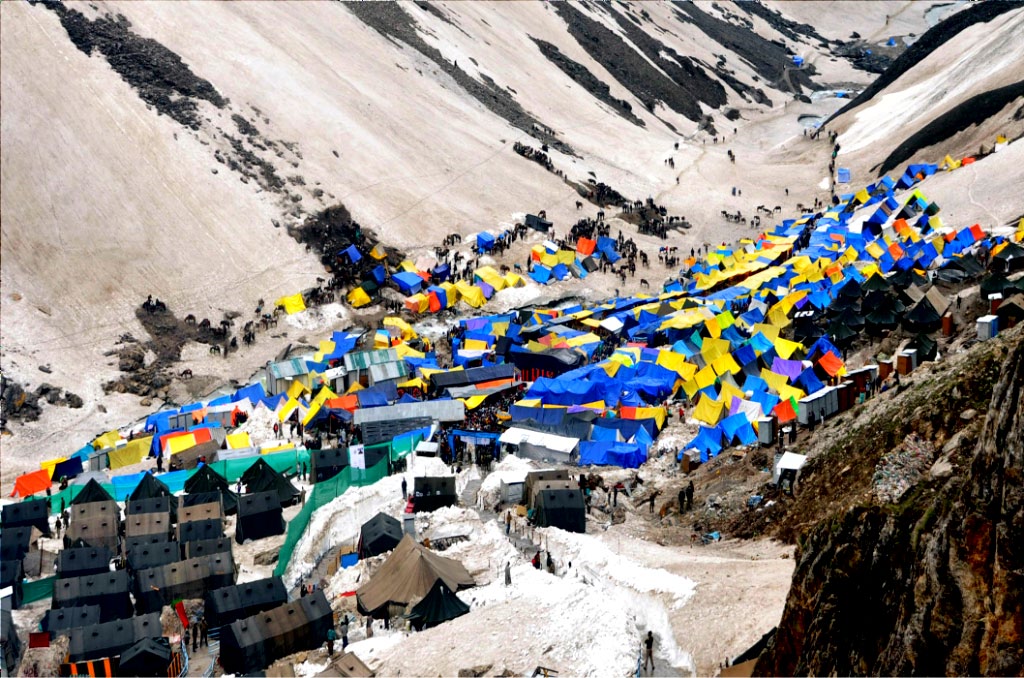
- Roads take you to the base camps of Amarnath situated at two places viz., Baltal Town and Pahalgam. The holy cave is located 14 km from Baltal town and 45 km from Pahalgam. Further travel through the rugged Himalayan terrain is either done on-foot or through pony-rides.
- Trains are available till Jammu, which is the nearest point to Amarnath connecting it with the rest of the country.
- Nearest airport is the Sheikh UL Alam International Airport at Budgam district. Helicopter Services are also available from Baltal and Srinagar.
Ancient origins of the Amarnath yatra and the mythological significance of the holy shrine
A fake, recent story related to the discovery of the cave by a Muslim shepherd from Batakot, named Buta Malik, became quite popular over time.
The annual Amarnath Yatra was flagged by J&K Lieutenant Governor Manoj Sinha on Wednesday (2nd July, 2025) from Jammu. The 38-day-long yatra, which will continue till 9th August, commenced amid tight, multi-tier security arrangements.
The first batch of 5,485 pilgrims, who left for the holy shrine of Lord Shiva yesterday under the protection of security forces, has returned safely. A second group of pilgrims left for the journey on Friday morning.
Yatra taking place amid heightened security arrangements
In the wake of the Pahalgam terrorist attack, the government has ramped up security arrangements for the Amarnath Yatra. From the base camps in Anantnag and Ganderbal districts till the holy cave shrine, the yatra is being closely guarded. The government has augmented the existing security arrangements comprising the Indian Army, BSF, CRPF, SSB, and local police. 180 companies of the Central Armed Police Forces (CAPFs) have been added to enhance security. A total of 581 CAPF teams have been deployed for the security of the yatra. Out of which 219 teams are from the CRPF and the rest are from the BSF, ITBP, CISF, and SSB. The entire stretch of the yatra is under constant surveillance to prevent any untoward incident. The CRPF has also deployed a team of all-women personnel at the Baltal route to assist female yatris during their journey.
Considering the cold temperatures and the challenging terrain, authorities have made arrangements for medical teams, air ambulances, and emergency evacuation to ensure the safety of all pilgrims during the yatra. Additionally, a team of 30 personnel from the CRPF’s mountain rescue team (MRT) has been deployed along the two routes of the yatra. They will attend to any medical emergency that may arise. The pilgrims will face high altitudes, about 3,888 metres, and low temperatures.
There are two routes to the Amarnath Cave, one is the traditional 48-km-long Nunwan-Pahalgam route in Anantnag district, and the other is the 14-km shorter but steeper Baltal route in Ganderbal district.

This year’s Amarnath yatra is expected to attract around 8 lakh pilgrims. Last year’s number was 5 lakh, the highest in the last 12 years. The holy journey to the shrine of Lord Shiva in the Amarnath cave holds immense religious significance in Hinduism.
Ancient origins of the Amarnath Cave
The Amarnath Cave is located in the Lidder valley of the Pahalgam tehsil of the Anantnag district, J&K. It is one of the most popular pilgrimage sites of the Sanatan Dharma. Since it is located at a high altitude, the shrine is covered in thick snow for most of the year, except for a brief period during the months of July-August. This period coincides with the holy month of Shravan as per the Hindu calendar. This is when devotees from across the country flock to visit the holy shrine for darshan of Baba Amarnath.
Inside the cave is a Swayambhu (formed on its own) Shiva Lingam. It is a stalagmite formation is formed when water drops fall from the cave’s roof onto the floor and freeze, resulting in an upward vertical development of the Lingam. The pilgrimage to the Amarnath caves is an ancient custom mentioned in Kalhana’s Rajtaringini, Nilamata Purana, Francois Bernier’s memoirs, and many others. Different stories have been associated with the pilgrimage
Mention of the Amarnath yatra in ancient scriptures
As per Hindu scriptures, the Amarnath cave was first discovered by Rishi Bhrigu. It is said that for centuries, the Kashmir valley was immersed in water, and Rishi Kashyap drained it by creating rivers and tributaries. As the water receded, Rishi Bhrigu, who was on his way to the Himalayas, discovered the Amarnath cave. The Amarnath Cave also finds mention in texts like the Bhringish Samhita and the Amarnath Mahatmy. These describe the topographical details of the cave.
Folklore related to the Amarnath Yatra
According to folklore, Lord Shiva narrated the secret of immortality to his consort Devi Parvati in the Amarnath cave. When Devi Parvati requested Lord Shiva to reveal the secret of immortality, he agreed to her request but said that he would narrate the secrets at an isolated place where no living being is able to hear the secrets. And, so Lord Shiva, along with Devi Parvati, left for the Amarnath Cave. On their way to the cave, Lord Shiva left his Nandi at Pahalgam. He left the moon on his head at Chandanwari, the snake (Sheshnag) around his neck at Lake Sheshnag, his son Ganesha at Mahaguna Parvat, and the Five Elements (Earth, Water, Air, Fire and Sky) at Panjtarni. He performed the Tandav dance as he kept leaving his belongings behind.
Thereafter, Lord Shiva entered the Amarnath cave with Devi Parvati and sat in Samadhi. Before that, he created Kalagni and ordered him to spread fire around the holy cave to ensure that no living being was able to hear him narrate the secrets of immortality. However, a pair of pigeons overheard the secrets of immortality. It is said that pilgrims often see pigeons around the Amarnath cave, surviving in such high altitudes and low temperatures, which affirms their belief in the folklore.
The fake story of Buta Malik
The Amarnath Cave has existed since time immemorial, but a fake, recent story related to the discovery of the cave by a Muslim shepherd from Batakot, named Buta Malik, became quite popular over time. According to the story, Malik took shelter in the cave after his flock strayed in the mountains, where a Sufi saint gave him a Kangri, a small pot filled with burning coal that is held close to the body to keep it warm. When he went home, he saw that the pot of coal had turned into a pot of gold. Overjoyed, he went back to the cave to thank the saint. But instead, he found only the cave and the Shiva Linga.
The folklore of Buta Malik is told by his descendants and local Kashmiris, as the legend is an amalgamation of Hindu religious traditions and its relation to the local Kashmiri Muslim population. The fake story is also peddled by left liberals and historians as an example of ‘Ganga-Jamuni Tehzib’. However, even a cursory search on the internet can expose the falsehood of the Buta Malik story.
Terrorists attacks on the yatra
The holy Amarnath Yatra is conducted under strict security arrangements due to the threat it faces from Islamic terrorists. In the last three decades, the Amarnath Yatra has been attacked by terrorists around 40 times. The yatra has been the target of Islamic terrorists since 1990. The first terrorist attack on the yatra took place in 1993. After that, the terrorists kept attacking the yatra for four consecutive years, till 1996.
The biggest attack on the yatra happened in 2000. Lashkar-e-Taiba terrorists opened indiscriminate fire at the Pahalgam base camp, in which 32 people died and about 60 people were injured. After this, there was another attack in 2001.
This was followed by another terrorist attack on the yatra in 2001. In this terrorist attack, grenades were thrown at the pilgrims’ camp near Sheshnag Lake, leaving 12 people dead and 15 injured. Similar terrorist attacks on the yatra took place in 2002 and 2006. In these attacks, buses carrying pilgrims were attacked with grenades. There was another terrorist attack on the yatra in 2017. After this, the government strengthened security arrangements for the Amarnath yatra, and as a result, no major terrorist attack took place on the yatra.
For the peaceful completion of Amarnath yatra this year, the government made all the security arrangements well in advance.
Amarnath, the famous Hindu shrine is different from other shrines in terms of its location and the structure of the journey. The trip is a truly mystical and divine experience.