 Kids Portal For Parents India Kids Network
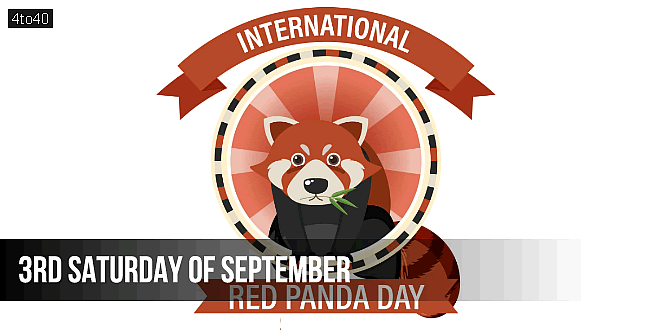
International Red Panda Day: It is observed on the third Saturday of September, and this year 2026 it falls on September 19. Let us read in detail about the day and some key facts about the red panda.
International Red Panda Day: Date
- 2026: 19 September, 2026 [Saturday]
- 2027: 18 September, 2027 [Saturday]
- 2028: 16 September, 2028 [Saturday]
Red panda is a reddish-brown, long-tailed, raccoon-like mammal. Its size is about the size of a large domestic cat. It is found within the mountain forests of the Himalayas and adjacent areas of eastern Asia.
International Red Panda Day is observed on the third Saturday of September every year. This year i.e. 2026 it falls on September 19. The day educates people about red pandas and threats to their survival.
History:
In 2010, Red Panda Network (RPN) launched International Red Panda Day (IRPD) with more than 16 schools and zoos across the world participating. The population of the red panda is declining globally. Approximately there are less than 10,000 remaining in the wild and maybe as few as 2500.
International Red Panda Day: Red Panda Threats
Globally, in 20 years, the population of Red panda has declined by 50% and there may be as few as 2,500 remaining in the wild. We can say that habitat loss is one of the threats.
A rapid increase in population in the Eastern Himalayas is causing deforestation, degradation, and fragmentation of red panda habitat. 70% of red panda habitat lies outside of protected areas in Nepal and is fragmented into 400 small forest patches.
Therefore, habitat is being fragmented by development projects like roads, hydro-projects, electric transmission lines, and mining, as well as settlement and agricultural conversions, and anthropogenic forest fires.
One of the major drivers of red panda habitat destruction is livestock herding. Unsustainable herding practices degrade habitat quality.
98% of red pandas eat bamboo. The life cycle of these plants is mass flowering. In disturbed areas, bamboo does not easily re-establish and so becomes difficult to find a fragmented forest. Red pandas become susceptible to other threats when crossing unsuitable habitats in search of it. Climate change is also one of the causes.
International Red Panda Day: Facts about Red Panda
- Common Name: Red Panda
- Scientific Name: Ailurus fulgens
- Type: Mammals
- Diet: Herbivore
- Average lifespan in the wild: 8 years
- Size: Head and Body: 20 to 26 inches, tail: 12 to 20 inches
- Weight: 6.5 to 14 pounds
– Red panda is also known as lesser panda, panda, red cat-bear, or red bear-cat.
– It has soft thick fur, above is rich reddish-brown and black underneath.
– The face of the red panda is white, consisting of a stripe of red-brown, and from each eye to the corners of the mouth. Also, the bushy tail is faintly ringed.
– They live high within the mountains among rocks, and trees and climb with agility.
-They are nocturnal and may live alone, in pairs, or in family groups.