 Kids Portal For Parents India Kids Network
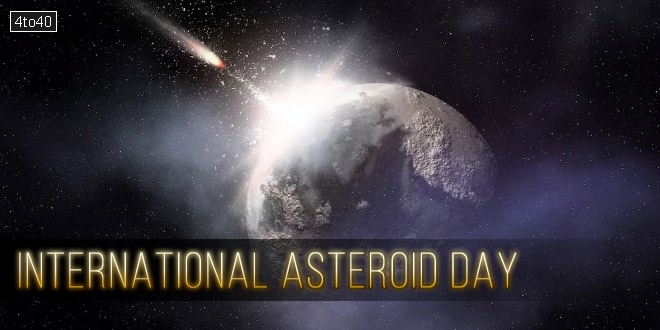
International Asteroid Day: In December 2016 the United Nations General Assembly adopted resolution A/RES/71/90, declaring 30 June International Asteroid Day in order to “observe each year at the international level the anniversary of the Tunguska impact over Siberia, Russian Federation, on 30 June 1908, and to raise public awareness about the asteroid impact hazard.”
International Asteroid Day: Date
- 2025: 30 June, 2025 [Monday]
- 2026: 30 June, 2026 [Tuesday]
- 2027: 30 June, 2027 [Wednesday]
- 2028: 30 June, 2028 [Friday]
Why Asteroid Day?
International Asteroid Day aims to raise public awareness about the asteroid impact hazard and to inform the public about the crisis communication actions to be taken at the global level in case of a credible near-Earth object threat.
The General Assembly’s decision was made based on a proposal by the Association of Space Explorers, which was endorsed by Committee on the Peaceful Uses of Outer Space (COPUOS).
Background:
Near-Earth objects (NEOs) represent potentially catastrophic threats to our planet. NEO is an asteroid or comet, which passes close to the Earth’s orbit. According to NASA’s Center for NEO Studies, there are over 16 000 Near Earth Asteroids discovered. The Tunguska asteroid event in Siberia, Russian Federation, on 30 June 1908, was the Earth’s largest asteroid impact in recorded history.
On 15 February 2013, a large fireball (technically, called a “superbolide”), traveling at a velocity of 18.6 kilometers per second, entered the atmosphere and disintegrated in the skies over Chelyabinsk. According to NASA, the approximate effective diameter of the asteroid was estimated at 18 meters and its mass at 11,000 tons. The approximate total impact energy of the Chelyabinsk Fireball, in kilotons of TNT explosives (the energy parameter usually quoted for a fireball), was 440 kilotons. The Chelyabinsk event was an extraordinarily large fireball, the most energetic impact event recognized since the 1908 Tunguska blast in Russian Siberia.
The United Nations Office for Outer Space Affairs (UNOOSA) has worked on NEOs for many years, recognising a NEO impact hazard as a global issue demanding an international response. Addressing such a hazard, including the identification of those objects that pose a threat of impact and planning a corresponding mitigation campaign, requires cooperative action in the interest of public safety on the part of the global community.
Building on recommendations for an international response to a near-Earth Object impact threat, endorsed by the Committee on the Peaceful Uses of Outer Space (COPUOS) in 2013, the International Asteroid Warning Network (IAWN) and the Space Mission Planning Advisory Group (SMPAG) were established in 2014.
The International Asteroid Warning Network (IAWN) uses well-defined communication plans and protocols to assist Governments in the analysis of possible consequences of an asteroid impact and to support the planning of mitigation responses.
The Space Mission Planning Advisory Group (SMPAG) is an inter-space agency forum that identifies technologies needed for near-Earth Object deflection, and aims to build consensus on recommendations for planetary defense measures.
Theme:
The Asteroid Foundation will celebrate this year’s Asteroid Day on 30 June 2025 and 1 July 2023 in Luxembourg. The programme will focus on education related to asteroids and, space highlighting the importance and impact of space ‘down to Earth’.
- 2022: Small is Beautiful
World Asteroid Day: Significance
World Asteroid Day or International Asteroid Day raises awareness about the devastating impact of an asteroid when it crashes to the Earth. The role of asteroids in the formation of our universe, how their resources can be used in the future, how asteroids provide the way for future exploration, and also how we can protect our planet from the impacts of asteroids.
Therefore, asteroids are rocky objects that are found orbiting around the Sun and also between the planets Mars and Jupiters. It is necessary to understand asteroid’s hazardous impacts. So, this World Asteroid Day is celebrated across the globe to educate people about asteroids and their impacts.
Facebook Covers, Banners & Posters


Top 10 Most Dangerous Asteroids
The Universe comprises of everything that exists from the galactic superclusters to the tiniest subatomic particles and has a radius of about 46 billion light years with age about 13 to 15 billion years. Asteroids are rocky bodies’ up to 800 kilometres in diameter, although most are much smaller with diameter less than a kilometre. In this article, we are giving, the top 10 list of most dangerous asteroids which are potentially hazardous object to the Earth.
The Universe comprises of everything that exists from the galactic superclusters to the tiniest subatomic particles and has a radius of about 46 billion light years with age about 13 to 15 billion years.
What is Asteroid Belt?
Asteroids are rocky bodies’ up to 800 kilometres in diameter, although most are much smaller with diameter less than a kilometre. The asteroid belt is the circumstellar disc in the Solar System located roughly between the orbits of the planets Mars and Jupiter. It is occupied by numerous irregularly shaped bodies called asteroids or minor planets. They are made of rock and stone. This is consists of, at least 40,000 asteroids that are more than 0.5 miles across. The dwarf planet called Ceres orbits the Sun in the asteroid belt.
Top 10 Most Dangerous Asteroids
The top 10 list of most dangerous asteroids on the basis of the report given by the International Space Agency are discussed below:
10. 2002 CE
It is a stony asteroid, classified as near-Earth object and potentially hazardous asteroid of the Amor group. It was discovered by astronomers of the LINEAR program at Lincoln Laboratory’s Experimental Test Site near Socorro, New Mexico, in the United States on 1 February 2002.
09. Geographos
It is a highly elongated, stony asteroid, near-Earth object and potentially hazardous asteroid of the Apollo group. It was discovered by astronomers Albert George Wilson and Rudolph Minkowski at the Palomar Observatory in California, United States on 14 September 1951. It will not intersect the Earth until 2586. Its orbit has an eccentricity of 0.34 and an inclination of 13° with respect to the ecliptic, so it is also a Mars-crosser asteroid.
08. Toutatis
It is an elongated, stony asteroid and slow rotator and considered as near-Earth object and potentially hazardous asteroid of the Apollo and Alinda group. It was discovered by French astronomer Christian Pollas at Caussols in 1989. It passed to the Earth in 2016 but according to the International Space Agency, it will not make another notably close approach until 2069.
07. Oljato
It is stony and extremely eccentric asteroid and sizable near-Earth object of the Apollo group. It was discovered by American astronomer Henry L. Giclas at the U.S Lowell Observatory in Flagstaff, Arizona, on 12 December 1947. According to the International Space Agency, it is a potentially hazardous celestial object due to its size and its Earth minimum orbit intersection distance (MOID) of 0.0031 AU (460,000 km), which is only about 1.2 lunar distances.
06. Midas
It is a vestoid asteroid considered as a near-Earth object. It was discovered by American astronomer Charles Kowal at Palomar Observatory in San Diego County, California on 6 March 1973. It has a low minimum orbit intersection distance with Earth of 0.0036 AU (Astronomical unit) but still listed in a potentially hazardous asteroid list.
05. Cuno
It is rare-type asteroid and considered as near-Earth object and potentially hazardous asteroid of the Apollo group. It was discovered by the German astronomer Cuno Hoffmeister at Boyden Observatory in Bloemfontein, South Africa on 5 June 1959. As per International Space Agency, it will approach to the Earth in the 21st century. It revolves on the eccentric orbit, so it is also a Mars and Venus-crosser.
04. Florence
It is a stony trinary asteroid of the Amor group and considered as a near-Earth object and potentially hazardous asteroid. It orbits the Sun at a distance of 1.0–2.5 AU once every 2 years and 4 months (859 days); the orbit has an eccentricity of 0.42 and an inclination of 22° with respect to the ecliptic. Hence, space agencies predicted that it has minimum orbit intersection distance (MOID ≤ 0.05 AU) and has potential to intersect the Earth.
03. Mithra
It is an eccentric asteroid and suspected contact-binary, considered as near-Earth object and potentially hazardous asteroid, approximately 2 kilometres in diameter. It belongs to the Apollo group of asteroids and is a relatively slow rotator. It was discovered by the Belgian astronomer Eric Elst and Bulgarian astronomer Vladimir Shkodrov at Rozhen Observatory on 22 September 1987. It had passed from the Earth on 14 August 2000.
02. Zephyr
It is a stony asteroid, classified as potentially hazardous asteroid and near-Earth object of the Apollo group, approximately 2 kilometres in diameter. It was discovered by astronomers of the Lowell Observatory Near-Earth Object Search at Anderson Mesa Station near Flagstaff, Arizona on 11 April 1999. Its orbit has an eccentricity of 0.49 and an inclination of 5° with respect to the ecliptic. Hence, the number of space agencies predicted that in future it will intersect with Earth in 2021, 2032 and 2043. It had already approached the Earth in 2010 but was crossed with marginal distance.
01. Bennu
It is a carbonaceous asteroid in the Apollo group discovered by the LINEAR Project on 11 September 1999. According to the latest research, it has 1 in 2700 chance of hitting Earth on the 21th of September 2135. It is considered as the potential hazardous celestial body on the list of the Sentry Risk Table. It is 54 million miles from the Earth and orbits Sun.
Top 10 Most Dangerous Asteroids:
| Name of Asteroid | Description |
| 01. Bennu | Discovered by: LINEAR Discovery date: 11 September 1999 |
| 02. Zephyr | Discovered by: Astronomers of the Lowell Observatory Near-Earth Object Search Discovery date: 11 April 1999 |
| 03. Mithra | Discovered by: Belgian astronomer Eric Elst and Bulgarian astronomer Vladimir Shkodrov Discovery date: 22 September 1987 |
| 04. Florence | Discovered by: Schelte J. “Bobby” Bus Discovery date: 2 March 1981 |
| 05. Cuno | Discovered by: C. Hoffmeister Discovery date: 5 June 1959 |
| 06. Midas | Discovered by: C. Kowal Discovery date: 6 March 1973 |
| 07. Oljato | Discovered by: H. L. Giclas Discovery date: 12 December 1947 |
| 08. Toutatis | Discovered by: C. Pollas Discovery date: 4 January 1989 |
| 09. Geographos | Discovered by: A. G. Wilson and R. Minkowski Discovery date: 14 September 1951 |
| 10. 2002 CE | Discovered by: LINEAR Discovery date: 1 February 2002 |
The above asteroids are considered as potentially hazardous object because of their high eccentricity and an inclination degree with respect to their ecliptic orbit.